
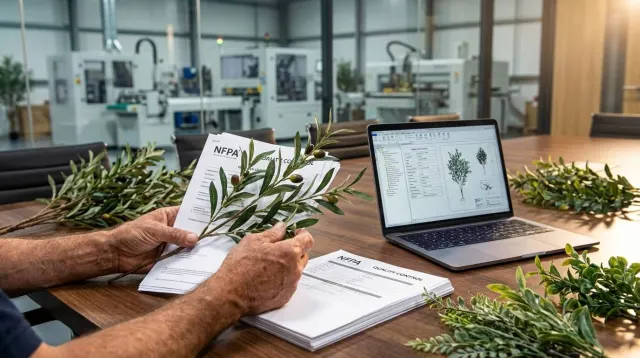
Many buyers believe Chinese plastic is recycled EU waste and that China can’t make inherently fire-retardant polymers. Both ideas are out of date. Here’s what really happened, and how to check FR compliance whoever your supplier is.
A Myth Worth Busting Before Your Next Project
You may have heard this story in procurement circles: China imports Europe’s plastic waste, recycles it into low-grade material, and so can’t match EU plastics. Some versions go further and say Chinese factories can’t make inherently fire-retardant (IFR) polymers at all.
It’s an easy story to believe, but it’s out of date and mostly wrong. If you buy artificial plants for hotels, retail or corporate spaces, believing it could cost you money, or lead you to the wrong supplier. This article covers what actually happened, where plastic in Chinese manufacturing really comes from, and how to check whether your greenery is truly fire-safe.
Where the Myth Came From
Like most myths, this one started with something true. For about 25 years, China was the world’s biggest buyer of plastic scrap. Between 1992 and 2016 it took in around 45% of the world’s plastic waste, and the US, UK and EU were among the largest exporters.
That trade ended years ago.
Operation National Sword (2018)
- From 1 January 2018, China banned imports of many waste categories, including most plastic scrap.
- It only allowed plastics with contamination below 0.05%. In practice, that’s close to a full ban.
- More categories were banned at the end of 2018 and 2019.
- Within a year, China’s plastic waste imports had dropped by about 99%.
The ban sent shockwaves through European recycling. EU and UK waste went to Southeast Asia instead, or stayed at home. So the idea that today’s Chinese plastic is made from European waste is several years out of date.
Where the Polymers in Chinese Manufacturing Actually Come From
China is not a recycler living off other countries’ leftovers. It is one of the world’s largest producers of virgin polymers. Industry estimates put it at about a fifth to a third of global plastics output, depending on the year and how you measure it. Its petrochemical industry makes:
- Virgin PE, PP, PVC and PET at huge scale
- Engineering-grade compounds for automotive, electronics and construction
- Masterbatches and additive packages, including UV stabilisers and flame-retardant systems
The same supply chains provide fire-rated cable sheathing, electronics housings and building materials, many of which are sold into the EU and certified to European standards.
So is recycled plastic used at all?
Yes, and it’s worth being honest about it. Recycled and off-spec material, now mostly from China’s own domestic waste, does go into some budget products. The problem isn’t the country. It’s how individual suppliers choose to source. A cost-cutting factory anywhere in the world can use poor feedstock. A specialist manufacturer chooses its compounds on purpose and can show you the paperwork.
Can Chinese Factories Make Inherent FR Polymers?
They can, and the good ones already do.
As we explain in our guide to the science of Inherent Fire Retardant (IFR) polymers, the key difference is this:
- Surface-treated FR: a finished leaf is dipped or sprayed with a flame-retardant coating. It can wash off, wear away or break down under UV, so protection fades over time.
- Inherent FR (IFR): the flame-retardant chemistry is compounded into the polymer before the leaf is moulded. Fire protection is part of the material itself. It doesn’t wash off or wear away.
IFR compounding needs good raw materials, controlled formulation and consistent processing. It doesn’t depend on which country the factory is in. Chinese compounders make IFR materials for many industries, and artificial foliage is one of the newer uses.
Where the real risk sits
The myth points buyers at the wrong problem. The real risks are:
- Suppliers who claim “FR” without independent test reports
- Certificates that cover leaves but not trunks, stems or bases. See why leaves and trunks need different certifications.
- Approved samples that don’t match the bulk order
- Coatings sold as “permanent” fire protection
None of these risks depend on where the factory is. They depend on testing and on how open the supplier is.
How to Check FR Performance, Wherever the Product Is Made
Don’t rely on assumptions about where a product came from. Ask for proof. Here’s a practical checklist for procurement teams.
1. Ask for third-party test reports
Ask for reports from recognised labs such as SGS, Intertek or Bureau Veritas. They should name the exact product and component tested. For thin materials like leaves, UL 94 VTM-0 is a strong benchmark. Also check what your local market requires, such as BS 476, EN 13501-1 or NFPA 701.
2. Confirm the FR is inherent, not a coating
Ask directly: “Is the fire retardant compounded into the polymer, or applied to the surface?” A specialist will answer clearly and can explain the material.
3. Check performance after ageing
Fire protection that disappears after a few months is no use to you. Ask whether samples were tested after conditioning or accelerated ageing. This matters most for UV-exposed outdoor installations.
4. Test every component
Leaves, stems, trunks, planters and moss can all be different materials. Each should have its own report.
5. Check bulk against samples
Agree in your contract that random units from the bulk order can be tested independently before shipment or on arrival.
6. Ask for a material declaration
A reliable supplier can say whether its polymers are virgin or recycled and give you the supporting documents.
Why This Matters for Commercial Buyers
For hotels, restaurants, airports and luxury retailers, fire compliance decides whether a project goes ahead or not. A failed inspection can mean:
- Delayed openings and contract penalties
- Removing and replacing installed greenery
- Damage to your reputation with clients and fire marshals
If you rule out a whole manufacturing region because of a myth, you could pay European distributor margins for products made in the same kind of factories. Or, worse, you could trust a supplier simply because it’s local, without checking its certificates.
The Xing Hui Approach
At Xing Hui Arts, we’ve been making artificial flowers, plants and trees in Huizhou since 1990. Our commercial FR ranges are built on inherent fire-retardant materials, independently tested to VTM-0, and supported by component-level certification. Our UV-stable outdoor ranges are made for harsh conditions and tested to withstand winds of up to 100 km/h.
Our European office in Gibraltar gives you Western-standard communication, weekly production updates, and paperwork your fire officer will recognise. You get the scale of Chinese manufacturing with the accountability of a European partner.
Key Takeaways
- China banned plastic waste imports in 2018, and imports fell by about 99%. Chinese plastic is not made from EU waste.
- China is one of the world’s largest producers of virgin polymers, including engineering grades and flame-retardant compounds.
- Inherent FR polymers are made in China and used across many industries, artificial foliage included.
- The real risk is weak verification, not geography. Ask for third-party reports, inherent (not coated) FR, results after ageing, and certification for every component.
Ready to Specify Fire-Safe Greenery With Confidence?
If you’re planning a hotel lobby, retail rollout or outdoor terrace and need artificial plants that will pass inspection, talk to our European team. Ask for our FR test reports, request samples, or get a quote for your next project. We’ll show you the documents behind every claim.
Suggested internal links: FR product range, UV outdoor collection, Contact / Request a Quote page, The “Fan Test” and Leaf Flexibility, Innovative Ways to Use VTM-0 Rated Plants in Luxury Retail.
Note to the editor: The original brief said China imports all its plastic from EU waste and therefore can’t make inherent FR polymers. That claim isn’t accurate. China has banned plastic waste imports since 2018 and makes virgin and flame-retardant polymers at scale. It also contradicts Xing Hui’s own IFR product claims. So this article sets the record straight instead. That makes it more useful to buyers and keeps it consistent with the brand.