
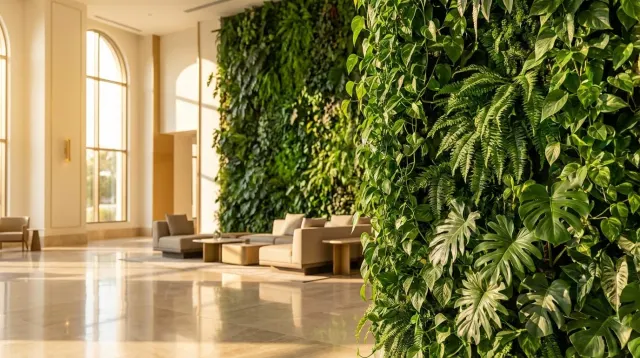
China produces most of the world’s artificial foliage, and European demand for realistic, certified greenery keeps growing. This guide covers the market data, regulation, freight costs and sourcing strategies that matter to commercial buyers in 2026.
Why the Economics of Artificial Greenery Matter Now
If you buy artificial trees, plants or flowers for hotels, retail chains, offices or garden centres in Europe, your margins depend on things you can’t see from your desk. Factory capacity in southern China, freight rates on the Asia–Europe route, and tightening EU safety rules all shape what you pay and when your stock arrives.
This guide sets out the big picture of the artificial plant and tree market in 2026. It covers China’s role as the world’s main production base, the forces behind European demand, what is happening with freight and regulation, and what all of this means for your next sourcing decision.
Market Size: Why the Estimates Disagree So Much
The first thing to know about this market is that no one agrees on how big it is. Research firms define the category in different ways. Some count only whole plants and trees, others add stem flowers, green walls and artificial grass, and they treat residential and commercial sales differently.
Here is how far apart the published estimates are:
- Value Market Research puts the global artificial plants market at USD 1.72 billion in 2026, rising to USD 2.46 billion by 2034 (4.53% CAGR).
- Dataintelo values the wider artificial plant market at USD 9.2 billion in 2025, with a forecast of USD 15.8 billion by 2034 (6.4% CAGR).
- Fortune Business Insights values artificial flowers alone at USD 1.86 billion in 2026.
The takeaway for buyers: don’t read too much into any single headline number. Nearly every serious forecast points the same way, with steady mid-single-digit growth each year and commercial uses leading. That consistency matters more than the absolute figures.
The Supply Side: China’s Place in Global Production
A Concentrated Manufacturing Base
China is the centre of global production. Citing UN Comtrade data, Value Market Research reports that China accounts for more than 70% of global artificial foliage exports. Dataintelo uses a broader definition and estimates that Chinese manufacturers control about 42% of global market supply, either selling directly or supplying Western retailers and brands.
Production is clustered in Guangdong and Zhejiang provinces. Each cluster combines moulding, finishing and logistics in one place. Factories, material suppliers and export forwarders sit close together, which brings three advantages:
- Economies of scale: large runs of PE and PU leaves, trunks and stems keep unit costs down.
- Speed of development: new species, colourways and sizes can go from sample to production quickly.
- Supply chain depth: UV-stabilised resins, fire-retardant treatments and steel armatures are all available locally.
Pricing Pressure and Its Hidden Cost
China’s dominance puts constant downward pressure on prices around the world. That benefits buyers, up to a point. When thousands of factories compete mainly on price, some of them cut corners: thinner materials, untested FR claims, colour that varies between batches, and weak communication once the deposit is paid.
This is why European buyers increasingly separate low-cost factories from specialist manufacturing partners. Chinese costs are low everywhere. The real difference between suppliers is quality control, certification and accountability.
The Shift to Direct Factory Relationships
MarkWide Research notes that event planners and interior designers are going around traditional wholesale distributors and dealing directly with factories, which removes layers of margin. Volume is moving towards vertically integrated Chinese producers that can handle specification work for European and North American design firms.
For importers and fit-out companies, this opens up savings, but only with a partner who can communicate to Western standards.
The Demand Side: What’s Driving Europe
A Large, Mature and Growing Market
Europe is one of the most valuable regions for artificial greenery. Sky Market Insights projects the European artificial plant and flowers market at USD 2.18 billion in 2026, reaching USD 3.94 billion by 2034, a CAGR of 7.7%. Fortune Business Insights reports that Europe held 28.32% of the global artificial flowers market in 2025, the largest regional share.
Within Europe, Cognitive Market Research ranks Germany as the largest national market, followed by the UK and France. Germany is also forecast to grow fastest of the three.
Five Forces Behind European Demand
- Rising labour and maintenance costs. Watering, pruning, pest control and replacing live plants is expensive in high-wage economies. Artificial greenery removes almost all of that ongoing cost.
- Hospitality and retail refurbishment. Hotels, restaurants and flagship stores refresh interiors often and want a lush look that stays the same in every season.
- Biophilic design without the biology. Developers and designers want greenery in spaces with little daylight, such as basements, atriums and corridors, where live plants struggle.
- Water scarcity and sustainability reporting. In southern Europe especially, cutting irrigation for outdoor landscaping is becoming both a cost decision and a reputational one.
- Regional design preferences. Dataintelo observes that Nordic buyers prefer minimalist, natural-looking designs, southern European markets favour vibrant and detailed florals, and central European buyers stress durability for commercial use.
Commercial Use Leads Premium Demand
Artificial trees are a small share of units but a large share of value. Sky Market Insights reports that trees made up nearly 15% of European market revenue, with higher average selling prices thanks to large installations and premium commercial projects. Its data also shows production and import volumes of more than 78 million units in 2025.
Regulation: The Factor Reshaping European Sourcing
Regulation shapes European procurement more and more. MarkWide Research points out that REACH compliance and changing fire-retardant standards in commercial spaces are pushing material specifications higher.
In practice:
- Fire safety is often mandatory. Hotels, shopping centres, airports, offices and public buildings typically require certified fire-retardant products. Depending on country and application, specifiers may cite standards such as EN 13501-1 or BS 476 in the UK.
- Chemical compliance is checked. Under REACH, importers must make sure their products don’t contain restricted substances above set thresholds.
- Outdoor products need proven UV stability. Cheap outdoor plants can fade within one Mediterranean summer, which leads to replacement costs and complaints.
For many buyers, a missing or questionable certificate is the main reason a project stalls. That is why certified FR and UV ranges carry a premium.
Logistics: Freight Rates in Late 2026
Your landed cost depends heavily on freight. At the time of writing, Asia–Europe container rates are well above where they were a year ago, but they have eased from the summer peak:
- Drewry’s World Container Index for 22 October 2026 shows Shanghai–Rotterdam at $3,632 per 40ft container, up 3% that week, and Shanghai–Genoa at $4,152.
- As of 1 October, Shanghai–Rotterdam was up 111% year-on-year, even after 12 straight weeks of decline.
- Carriers keep announcing blank sailings and rate increases to support prices, and some vessels are still rerouting around the Cape of Good Hope.
Artificial trees and large plants take up a lot of space relative to their value, so freight can be a large part of landed cost. Efficient packing, knock-down designs and full-container consolidation directly affect your margin.
What This Means for European Buyers
Putting these trends together, here are the practical implications:
- Plan around Chinese New Year and peak season. Order early so stock arrives before Q1 production shutdowns and Q3 freight surges.
- Ask for certificates before you ask for prices. FR and UV certificates should come from recognised testing laboratories and should match the exact product you are buying.
- Pay attention to packing. Ask how many units fit in a 40HQ container. Better packing can save more than a small cut in unit price.
- Look at total cost of ownership. A slightly more expensive UV-stable tree that lasts for years is cheaper than a budget tree you replace every season.
- Choose partners who communicate. Time zones, language barriers and slow replies cost money. Look for a supplier with European-facing account management.
- Consider bespoke development for large projects. Big hospitality and retail rollouts benefit from custom species, sizes and colours developed directly with the factory.
The Bridge Between Chinese Manufacturing and European Expectations
The macro picture creates a clear opportunity. Europe wants realistic, compliant and durable artificial greenery, and that demand keeps growing. China has the scale and cost advantage to supply it. What has been missing is a reliable link between the two.
That is where Xing Hui Arts comes in. We combine Chinese manufacturing with Western communication standards and European-grade certification. Our specialist ranges include:
- Statement artificial trees for hotel lobbies, atriums and retail flagships
- UV-stable outdoor plants and trees, built to withstand winds of up to 100 km/h
- Fire-retardant certified ranges for commercial and public spaces
- Bespoke developments for large-scale projects
We aren’t a transactional factory. We aim to be a long-term supply partner for wholesalers, importers, interior designers and fit-out companies who can’t afford mistakes.
Key Takeaways
- Global market estimates differ widely, but all point to steady growth led by commercial applications.
- China supplies most of the world’s artificial foliage, with production clustered in Guangdong and Zhejiang.
- European demand is strong, especially in Germany, the UK and France, driven by maintenance savings, hospitality refurbishment and biophilic design.
- Fire safety, REACH and UV stability now play a decisive part in sourcing decisions.
- Freight on the Asia–Europe route remains volatile, so packing efficiency and timing matter.
Planning your next container or a large commercial project? Contact the Xing Hui Arts team to talk through certified FR and UV ranges, factory-direct pricing and project support from our European-facing office.
Suggested internal links: Artificial Trees | Green Walls