
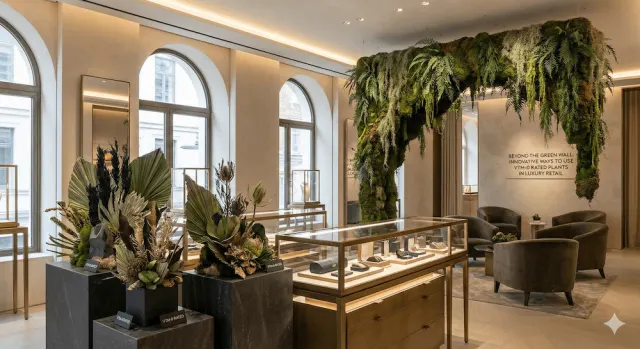
In 2026, artificial flowers, plants and trees stopped being finishing touches and became architectural elements. We look at the trends that shaped commercial interior landscaping this year, including hyper-realism, statement trees, fire safety, UV-stable outdoor ranges, and what they mean for your 2027 projects.
2026: The Year Artificial Greenery Became Architecture
A few years ago, artificial plants were often added at the end of a fit-out to fill an empty corner. In 2026 that changed. Designers, specifiers and procurement teams now treat artificial flowers, plants and trees as architectural elements, specified early, held to compliance standards and expected to perform for years.
As the year draws to a close, we’ve looked at what we saw in interior landscaping across Europe, the UK, the USA and the Middle East. These are the trends that shaped commercial projects in 2026, and what they mean for planning your 2027 schemes.
1. Hyper-Realism Is Now the Baseline
Realism is no longer a selling point. It’s the minimum buyers expect. Across the industry, real-touch finishes became the standard for premium specifications in 2026: foliage that feels soft, bends naturally and has no plastic shine.
What changed is where realism matters most. In hotel lounges, restaurant booths and retail displays, guests are often within arm’s reach of the greenery. A plant that looks convincing from five metres away but obviously fake up close lowers the perceived quality of the whole space.
What buyers are prioritising:
- Natural colour variation within a single leaf, not flat uniform greens
- Deliberate imperfections such as asymmetry, varied leaf sizes and natural branching
- Realistic trunks and stems, especially on large trees where the bark is at eye level
- Matte finishes that read as organic under strong commercial lighting
If your current supplier’s samples only look convincing in photographs, 2026 made it clear that clients will notice.
2. Statement Trees Define the Space
One of the strongest movements this year was the use of large sculptural trees as focal points. Olive trees, ficus, palms and bird of paradise are being placed to define zones, guide footfall through open-plan areas and soften hard architectural lines.
In hotel lobbies, atriums and corporate receptions, one well-proportioned tree often replaces a scattered group of smaller pieces. The effect is calmer, more confident and more premium.
Custom Sizing Is in Demand
Standard catalogue heights don’t always suit double-height lobbies or unusual ceiling lines. More projects in 2026 asked for bespoke specifications: adjusted heights, denser or more open canopies, and trunk shapes matched to a design concept. For large commercial jobs, being able to build to a drawing rather than to a catalogue is becoming essential.
Explore our artificial trees range for statement pieces built for commercial interiors.
3. Mediterranean Modernism and Japandi Calm
Two styles led the year:
- Mediterranean Modern: The olive tree became the signature species of 2026. Its silvery-green foliage and gnarled trunks suit warm neutrals, limewash walls and natural stone, which are popular in hospitality from London to Dubai.
- Japandi and industrial loft styles: Bamboo, pine and dracaena gained ground. Bamboo in particular works well as a light, airy screen that divides spaces without blocking light.
The common thread is controlled naturalism: greenery that looks relaxed and less manicured, with a carefully designed overall composition.
4. Vertical Greenery and Moss Panels Go Mainstream
Floor space is valuable in commercial property, so walls became the new canvas. Artificial green walls and botanical wall panels were among the most-photographed features in 2026 hospitality and retail fit-outs.
They work especially well in:
- Reception backdrops and branded feature walls
- Windowless corridors and lift lobbies where live plants can’t survive
- Restaurant and bar interiors that need an immersive atmosphere without irrigation
- Corporate offices where biophilic design supports staff wellbeing goals
Moss panels also moved beyond greenery and into design. Paired with metal, timber or concrete, they add texture and acoustic softness to luxury retail and workplace interiors.
See our green walls collection for vertical solutions.
5. Richer, Moodier Colour Palettes
Bright greens gave way to more sophisticated tones in 2026. Deep olives, rich emeralds, darker foliage and verdigris-tinged greens suited the warmer, earthier interiors designers favoured this year.
Artificial flowers followed the same direction. Hospitality clients increasingly chose muted, tonal arrangements over bright displays, and many used seasonal floral rotations to refresh a space several times a year without the waste and labour of fresh flowers.
6. Fire Safety Moved From Nice-to-Have to Non-Negotiable
This may be the most important commercial trend of the year. Fire-retardant certification is now checked earlier in specification and enforced more strictly at handover.
For hotels, restaurants, shopping centres, airports and offices, building safety requirements mean decorative greenery must be supported by valid fire-retardant (FR) test documentation. Projects without it risk failed inspections, delayed openings or costly last-minute replacements.
Our advice for 2027 projects:
- Ask for FR certification before sampling, not after ordering
- Confirm which standards the certificates cover for your target market
- Make sure certification applies to the finished product, not just the raw material
- Keep documentation on file for building management and insurers
In our experience, missing or unclear FR documentation is one of the most common reasons commercial greenery orders get held up. It’s an easy problem to avoid with the right partner.
7. The Indoor-Outdoor Line Has Disappeared
Rooftop bars, terrace restaurants, hotel pool decks and covered retail walkways all grew in importance in 2026, and buyers wanted the same lush look outdoors as indoors.
That raised the performance bar sharply. Outdoor artificial greenery has to handle:
- Intense UV exposure, especially in the UAE, southern Europe and the southern USA, where untreated products fade quickly
- High winds on rooftops and coastal sites. Our outdoor plants and trees are built to withstand winds of up to 100km/h
- Temperature swings and rain, without colour bleeding or structural failure
UV-stable artificial plants are no longer a niche category. Buyers who once kept outdoor greenery to a minimum because of fading are now specifying complete schemes for outdoor spaces.
8. Lifecycle Thinking and Sustainability Questions
Sustainability questions about artificial plants became more common this year, and the conversation matured. Rather than asking whether artificial is better than live, buyers asked about lifespan and total cost of ownership.
A high-quality artificial tree that looks good for many years, with no water, no lighting, no replacement after failing in a dark lobby and no regular maintenance visits, makes a strong case on cost and practicality. Cheap products that fade or look tired within a season do not.
The lesson from 2026 is that durability and quality are sustainability considerations in their own right.
9. Buyers Want Partners, Not Just Factories
The final trend is about how products are sourced rather than the products themselves. In 2026 many wholesalers, importers and fit-out companies shortened their supplier lists and favoured manufacturers who offer:
- Clear, timely communication in their working language and time zone
- Consistent quality from sample to bulk production
- Certified ranges that remove compliance risk
- Project coordination for multi-container, multi-site rollouts
After years of inconsistent quality and slow replies from overseas factories, buyers are putting reliability and accountability ahead of the lowest unit price. On a large-scale project, a supplier who misses a deadline or ships the wrong spec costs far more than a small price difference.
What These Trends Mean for Your 2027 Projects
If you’re planning commercial interior landscaping for next year, here are the key takeaways:
- Specify realism at close range. Judge samples in your real lighting and at arm’s length.
- Think in statement pieces. Fewer, larger and better-proportioned trees often look more premium.
- Use vertical surfaces. Green walls add impact without taking floor space.
- Lead with compliance. Get FR certification confirmed before you commit.
- Choose genuinely UV-stable products for outdoor spaces, and check wind resistance for rooftops.
- Pick a partner, not a price. Reliability protects your timelines and your reputation.
Partner With Xing Hui Arts for 2027
At Xing Hui Arts, we combine factory-direct manufacturing with Western communication standards and European-grade certifications. Our artificial trees, plants and flowers are built for commercial spaces where realism, safety and reliability matter, including fire-retardant certified ranges, UV-stable outdoor collections and bespoke developments for large-scale projects.
Planning your 2027 schemes? Get in touch with our team to talk through your project, request samples or ask about certification for your market. We’ll help you get ahead of the trends without the usual sourcing problems.