
In the global B2B artificial foliage market, a “pass” on a fire test is only half the story. The more critical question for architects, developers, and hospitality procurement managers is: How long will that safety last?
Many low-cost artificial plants are treated with surface-level chemicals that provide a temporary shield. However, a professional-grade product, one destined for a high-traffic airport in the UK or a luxury resort in the UAE, must prove that its safety properties are stable over years of environmental exposure. This is where the 168-hour thermal ageing test becomes the definitive line between a compliant product and a future liability.
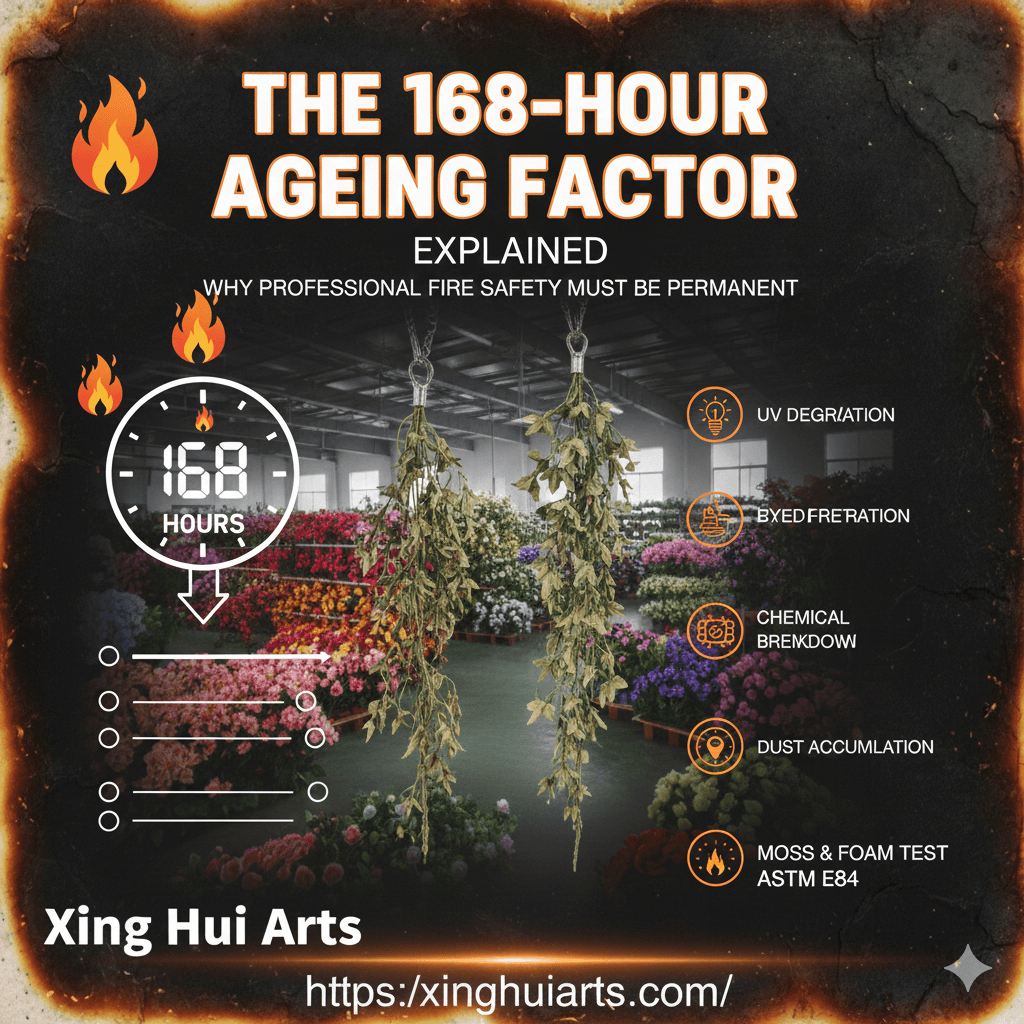
What is the 168-Hour Ageing Test?
In high-level laboratory protocols, such as those governed by the UL 94-2023 standards, specimens are not only tested in their “as received” state. They must also undergo a rigorous conditioning process designed to simulate years of real-world use in a matter of days.
This process involves placing the material specimens, both thin films for leaves and structural polymers for trunks, into a precision oven at a constant temperature of 70 °C for exactly 168 hours (7 full days). Following this heat exposure, the samples are cooled in a desiccator at 23 °C for at least 4 hours to stabilise their moisture content.
The “Migration” Problem: Why Ageing Matters
The primary reason for this intense heat treatment is to test for chemical migration. In poorly manufactured fire-retardant (FR) plastics, the flame-retardant additives are not properly bonded to the polymer chain. Over time—especially in warm environments like office buildings or regions like the Middle East—these chemicals can “migrate” to the surface of the leaf and evaporate or be wiped away during routine cleaning.
If a plant passes a fire test without being aged, it may be a fire hazard within 12 to 24 months of installation. By demanding a report that includes the 168-hour ageing cycle, a buyer ensures that the fire retardancy is Inherent (IFR), meaning it is locked into the material’s DNA and will not degrade over time.
Analysing the Results: Before vs. After Ageing
When reviewing technical documentation, professional buyers look for consistency between two sets of data:
- “As Received” Conditioning: The performance of the product straight from the factory.
- “After Ageing” Conditioning: The performance after the 168-hour oven cycle.
In premium manufacturing, the results should be nearly identical. For example, in tests for thin material vertical burning, a sample might show an afterflame time of 0 seconds when fresh. To be truly commercial-grade, that same material should still show an afterflame time of 0 seconds after being aged for a week at 70 °C. This consistency proves that the polymer’s safety additives are thermally stable.
The Role of Precision Equipment
To achieve these repeatable results, manufacturers must utilise calibrated laboratory equipment. High-specification ovens, such as the Model UF750, are used to maintain the exact thermal environment required for the ageing process. This ensures that every leaf produced in a 40ft container order has the same molecular integrity.
Why This is Critical for the Europe and Middle Eastern Markets
For our partners in Europe, the UAE and surrounding regions, the ageing test is even more relevant. Interior temperatures in glass-fronted lobbies or outdoor installations can reach extreme levels. If the foliage has not been verified through a thermal conditioning process, the intense heat and UV exposure can quickly compromise the plant’s safety and aesthetic integrity.
By specifying plants that have passed the 168-hour, 70 °C protocol, installers in Dubai, Riyadh, and Abu Dhabi can guarantee their clients a product that remains safe and vibrant despite the harsh climate.
Summary: The Buyer’s Checklist for Long-Term Safety
When evaluating a manufacturer for a large-scale project, do not just look for the words “Fire Retardant.” Demand the technical proof of stability:
- Request the Test Method: Ensure it follows UL 94-2023 or equivalent international standards.
- Check for the Ageing Cycle: Confirm that specimens were conditioned for 168 hours at 70 °C.
- Compare the “Afterflame” Times: Look for 0-second or low-second results in both the “as received” and “after ageing” columns.
- Verify Classification: Ensure the thin materials (leaves) achieved a VTM-0 rating, which is the gold standard for preventing flame spread.
Conclusion
At Xing Hui Arts, we believe that safety is not a “moment in time”, it is a permanent feature of high-quality engineering. By adhering to the most rigorous thermal ageing protocols in the industry, we provide our global partners with the peace of mind that their 40ft container orders are filled with products that are built to last and designed to protect.