
In the landscape of modern commercial architecture, the integration of biophilic design—bringing the “outdoors in”—is no longer a luxury; it is a psychological necessity. However, when designing for high-occupancy, high-traffic environments such as international airports, state-of-the-art hospitals, and expansive luxury shopping malls, the designer’s primary challenge is not aesthetics, but Life Safety.
In these “Extreme Environments,” every material introduced into the space must be scrutinised for its contribution to fire load, smoke toxicity, and flame spread. This is why the distinction between standard decorative plants and UL 94-2023 certified foliage is the most important decision a procurement manager will make.
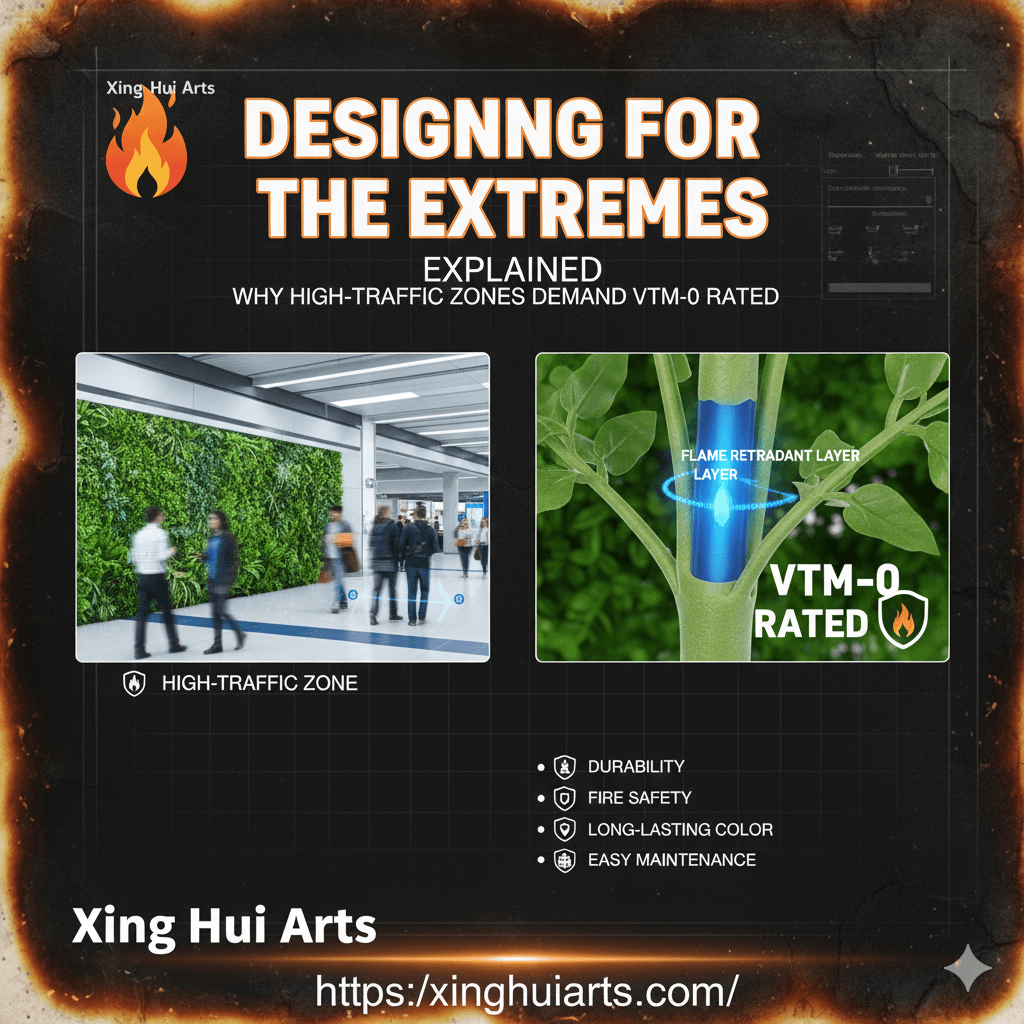
The Airport Challenge: Egress and Flame Spread
International airports are perhaps the most demanding environments for interior designers. They are massive, high-ceilinged structures where thousands of passengers are in constant motion. In the event of an emergency, the “Egress Paths”—the routes people take to exit the building—must remain free of smoke and fire.
When a designer specifies a 5-meter artificial Ficus tree for a departure lounge, they are adding a significant surface area of polymer to the room. If that material is not VTM-0 rated, it can act as an accelerant. Our engineering standards ensure that even the thinnest leaves on a large-scale installation are tested to self-extinguish within 10 seconds of flame contact. For airport safety officers, this “Zero Progress” performance is the difference between an approved installation and a rejected one.
The Healthcare Mandate: Bacteria and Burn Ratings
In hospital and healthcare settings, the requirements are two-fold: hygiene and fire safety. Unlike real plants, which carry soil-borne pathogens and require water (a source of potential mould), high-end artificial foliage provides the “healing power of green” without the biological risk.
However, hospitals are “defend-in-place” facilities, meaning that in many emergencies, patients cannot be easily evacuated. Therefore, the interior materials must have the highest possible fire resistance. Utilising VTM-0 thin-material certified leaves ensures that even in oxygen-rich medical environments, the greenery will not contribute to a fire’s intensity. Furthermore, the thermal conditioning process—where materials are aged for 168 hours proves that the fire-retardant chemicals will not “off-gas” or migrate to the surface, maintaining a sterile and safe environment for patients.
Luxury Retail and the “Drip” Factor
In luxury retail and high-end malls, the primary fire safety concern is often the “Drip Factor.” During a fire, many standard plastics melt and produce flaming droplets that fall onto carpets, furniture, or—most dangerously—people below.
The UL 94 Section 11 test specifically monitors for this behaviour. To achieve the VTM-0 classification, a material must produce zero flaming drips that ignite the surgical cotton indicator placed beneath the sample. For a retail developer, this means a green wall installed over a high-value merchandise floor is not just a visual asset, but a safety-compliant component that protects both the assets and the customers.
Strategic Application: Mixing VTM-0 and V-2 Components
A truly professional commercial installation is a composite of different materials, each requiring specific testing.
- The Canopy (Leaves and Petals): These must meet VTM-0 (Section 11) because their high surface-to-mass ratio makes them highly flammable if untreated.
- The Structure (Trunks and Stems): These larger components should meet V-2 or higher (Section 8) to ensure the vertical integrity of the plant during heat exposure.
By understanding this hierarchy, designers at Xing Hui Arts can engineer bespoke solutions. We don’t just provide a “generic” plant; we provide a structural decor system where every component—from the printed film of the leaf to the polymer of the trunk—has been validated through rigorous laboratory conditioning.
The Global Compliance Bridge: From China to the World
Operating at a scale that moves 50+ containers per year requires more than just a factory; it requires a global compliance infrastructure. While our manufacturing center utilizes state-of-the-art horizontal and vertical flame chambers to verify every batch, our Gibraltar-based European office serves as the technical translator for our clients.
Whether you are a procurement manager in London dealing with UK building codes, a developer in Dubai adhering to the UAE Fire & Life Safety Code, or an architect in New York following UL standards, our documentation is designed to be “Marshal-Ready.” We provide the raw data—afterflame times, total afterglow, and conditioning logs to ensure your project moves from the drawing board to the final walkthrough without a single compliance hurdle.
Conclusion: Investing in Peace of Mind
Designing for high-traffic zones is an exercise in risk management. By choosing Inherent Fire Retardant (IFR) foliage that has been proven to resist flame progression and eliminate flaming drips, you are investing in the long-term safety of the facility.
At Xing Hui Arts, our mission is to ensure that the beauty of biophilic design never comes at the expense of human safety. Our 2025-2026 product line is the result of years of polymer research, culminating in a collection that is as safe as it is stunning.